Petroleum engineers frequently rely on compositional models, such as equations of state (EoS), to predict hydrocarbon fluid phase behaviour, typically represented by detailed 3D PVT diagrams. Yet, as with many models, the devil is in the details. Consider a simple single-component fluid like pure water: the phase transitions between gas, liquid, and solid states are clearly defined and fully reversible. Cross the phase boundary, ice melts into water or water freezes into ice, straightforward and predictable. However, when dealing with multicomponent systems, like volatile oils, the question arises: Are phase changes equally reversible?
Multiple studies have documented that gas re-dissolution into oil is considerably slower than gas liberation (exsolution) from oil. For example, Bogachev et al. noted that in real oil and gas-condensate systems, the dissolution of gas is “much slower” than the liberation of gas from oil. Experimental PVT studies also show phase change hysteresis.
The prevailing explanation for the slower re-dissolution is rooted in mass transfer limitations at the gas–oil contact. When pressure is increased above the bubble point, the oil immediately in contact with the free gas becomes saturatedwith dissolved gas (essentially at equilibrium with the gas phase at that interface). Further gas can only dissolve if it diffuses away from the interface into the bulk liquid, creating capacity for more gas uptake. This diffusion-driven process is relatively slow, especially for multicomponent oils. In other words, once the interfacial oil layer holds as much gas as it can (at the given pressure and temperature), additional gas molecules must migrate deeper into the liquid before new gas from the bubble can dissolve. In short, the gas–oil interface acts as a bottleneck: it equilibrates quickly locally, but the bulk equilibration behind the interface lags, thus slowing the overall dissolution rate.

In my experience, two practical examples vividly illustrate this phenomenon:
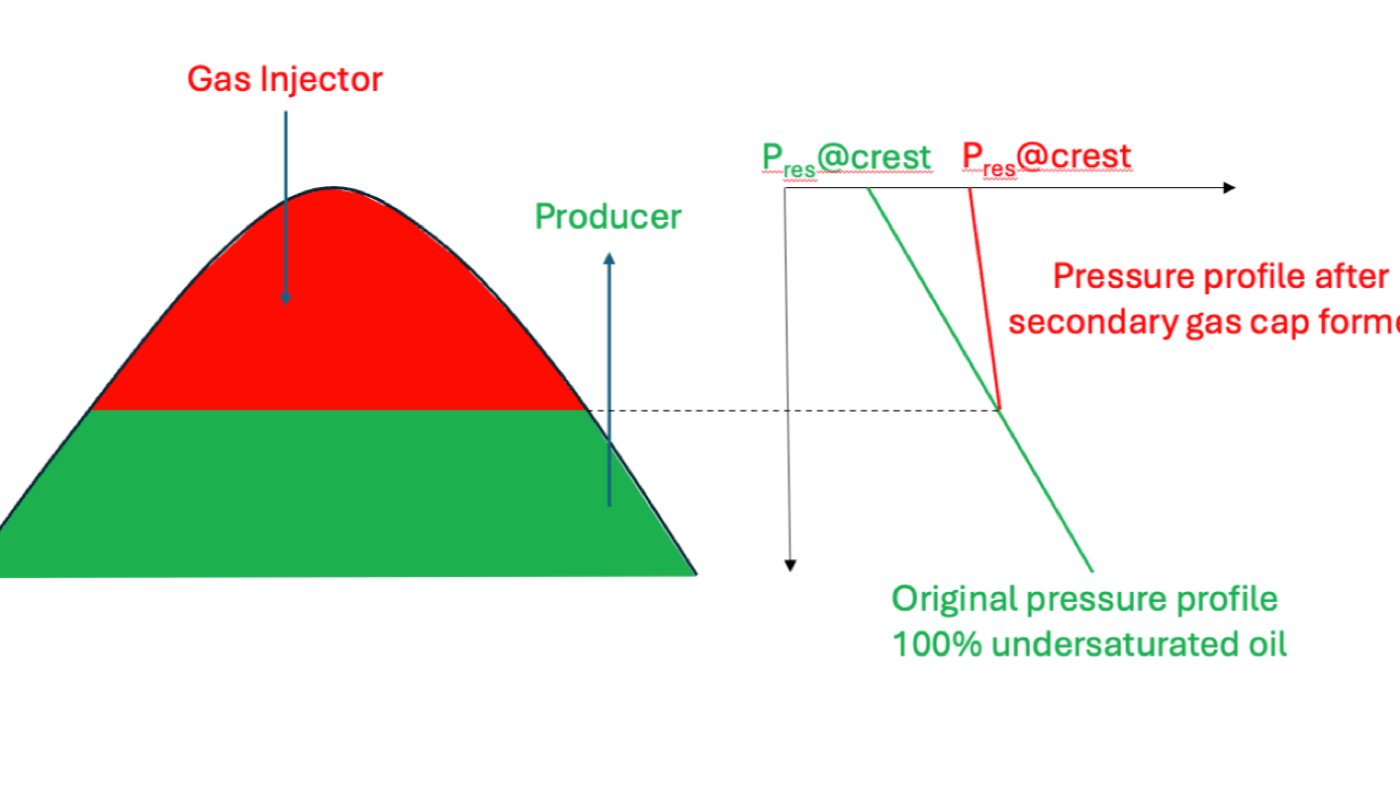
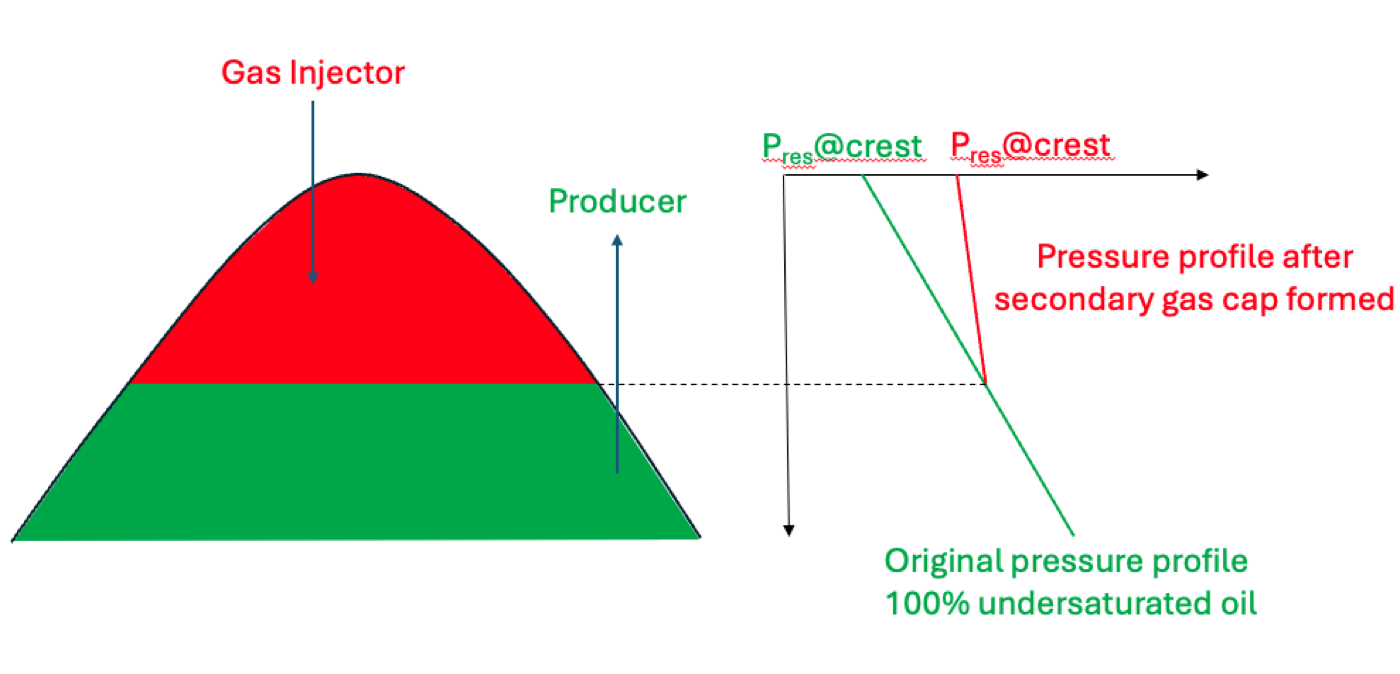
- Reservoir Pressure Maintenance via Gas Reinjection: Initially, our reservoir was undersaturated with no gas cap. Depletion caused the reservoir pressure to drop below the bubble point, resulting in the formation of a secondary gas cap. Subsequent gas injection raised reservoir pressures back above the bubble point, yet the gas cap persisted due to non-equilibrium kinetics, the saturated interface slowed further gas dissolution. Thus, engineers carefully controlled gas injection rates to prevent pressures at the structure’s top from exceeding original pressures, mitigating risks to structural sealing integrity.
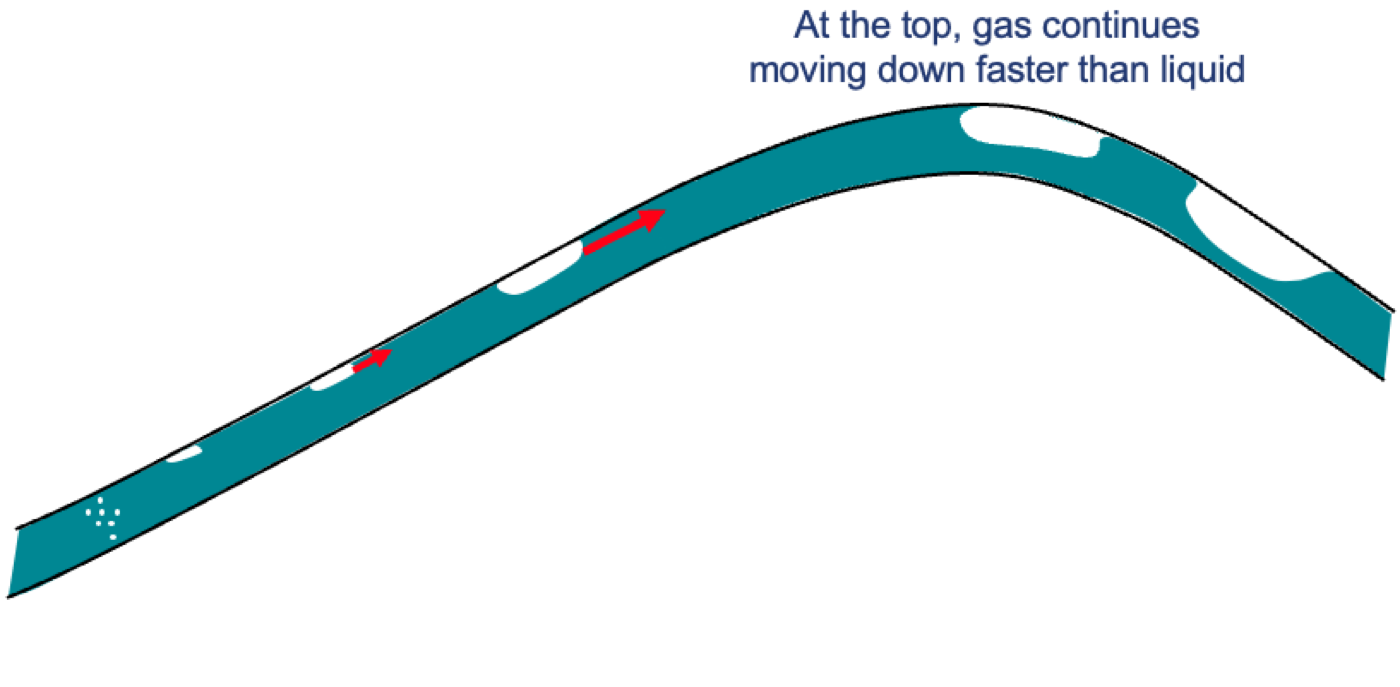
- Live Oil Pipeline Transport: Another scenario involved transporting live oil through pipelines with significant elevation changes. As oil ascended, the reduced pressure caused gas to liberate from the oil. When the pipeline descended, pressures increased again, but slow gas re-dissolution kinetics, compounded by differences in superficial velocities between gas and liquid phases, prevented immediate re-absorption of gas. Such scenarios necessitated careful pipeline design and operational adjustments.
These examples underscore the necessity for petroleum engineers to factor non-equilibrium kinetics into operational and design considerations,, particularly regarding reservoir seal integrity and multiphase handling.
Have you observed similar non-equilibrium behavior in your operations? I’d be interested in hearing your insights or experiences.
References:
- Indrupskiy, I. M., et al. *“Non-equilibrium phase behavior of hydrocarbons in compositional simulations and upscaling.”*Computational Geosciences 21 (2017): 1173–1188.
- Bogachev, K. Y., et al. “Numerical Modeling of Non-Equilibrium Phase Transitions in Isothermal Compositional Hydrocarbon Flow Simulations.” SPE 196871-MS, Proc. SPE Russian Pet. Tech. Conf., 2019.
- Indrupskiy, I. M., et al. “Assessment of Non-Equilibrium Phase Behavior Model Parameters for Oil and Gas-Condensate Systems by Laboratory and Field Studies.” SPE 201956-MS, 2020.
- Ratnakar, R. and Dindoruk, B. “The Role of Diffusivity in Oil and Gas Industries: Fundamentals, Measurement, and Correlative Techniques.” Processes 10, no. 6 (2022): 1194.