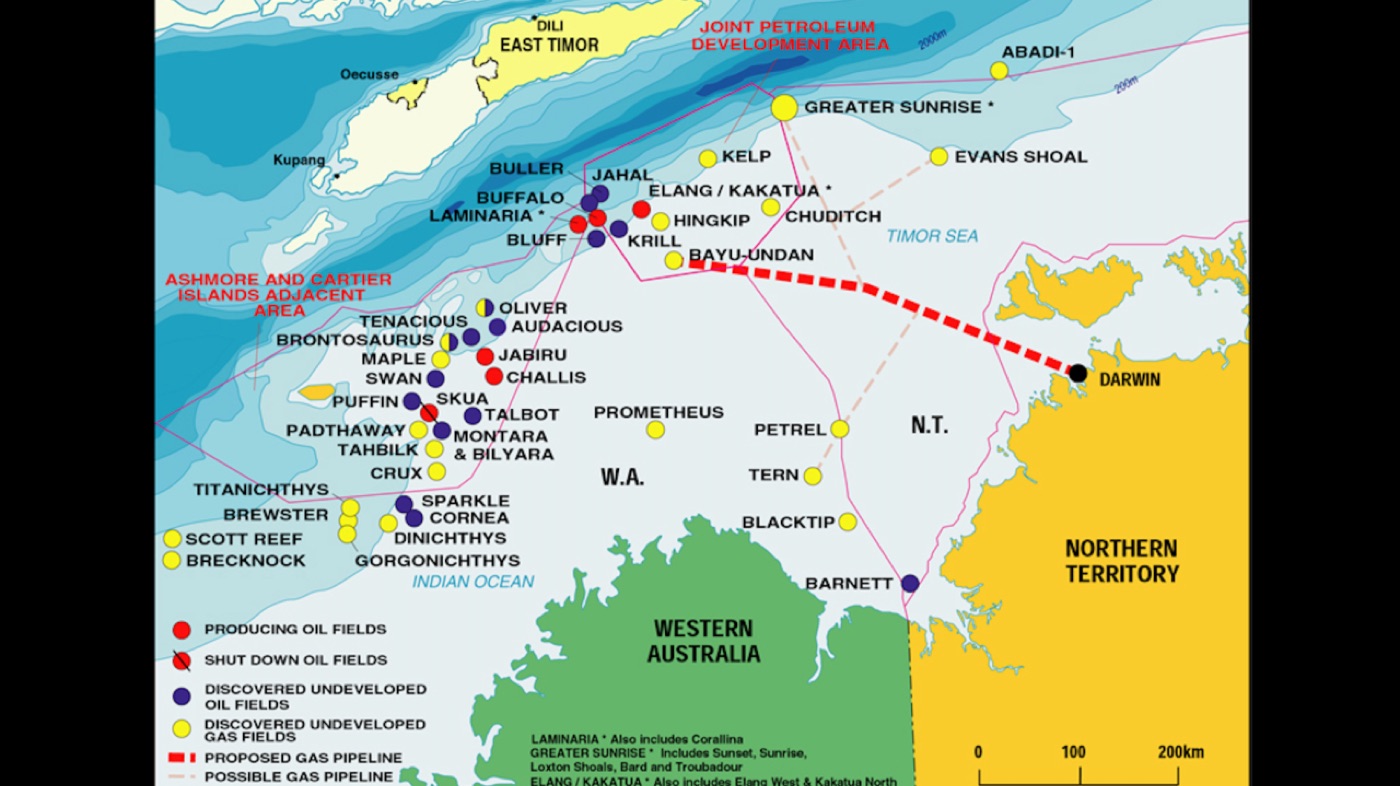
In 1983, Broken Hill Propriety company (aka BHP) drilled an exploration well called Jabiru 1 in the Timor Sea, 640 kms northwest of Darwin.
The company had been mining coal and making steel for a century. It knew rocks. It knew heavy industry. What it did not know, with any great confidence, was how to develop an offshore oil field in one of the most remote stretches of water on the Australian continental shelf.
What followed over the next two decades is one of the least told but most consequential chapters in Australian offshore development history. A mining company with no offshore operating pedigree built some of the first floating production systems ever deployed in Australian waters, pioneered subsea development concepts that would become standard practice, and in doing so, opened up an entire petroleum province.
Running parallel to that achievement was something else entirely. A gas and condensate discovery made in 1974, confirmed as one of the largest untapped resources in the region, sat idle for half a century while governments argued over who owned it. That resource, Greater Sunrise, is still waiting to produce its first molecule of gas.
BHP: The New Kid Who Built the Neighbourhood
By the early 1980s, Australia’s offshore petroleum industry was concentrated in Bass Strait, where BHP had been watching the big boy, Esso, operated Australia’s biggest oil and gas fields since the late 1960s.
Jabiru offered something different. BHP would be the operator, making the calls, taking the risks, and learning the lessons firsthand. The first operatorship is often the make or break.
The field presented an immediate problem. Only one out of four appraisal wells showed genuinely promising potential. At the time of sanction, OOIP was estimated at around 45 MMbbls. It sat in 110 metres of water with no existing infrastructure within hundreds of kms. No pipelines, no platforms, no supply bases. Just open ocean between the field and Darwin.
For a company with limited offshore operating experience, the conventional wisdom would have been to walk away, wait for someone else to build the infrastructure, or find a more experienced partner to take the lead. BHP did none of those things. Instead, its engineers took a hard look at the options and chose what was, at the time, a bold approach: a floating production, storage and offloading vessel (FPSO) with subsea completions.
Jabiru came on stream in August 1986, just 3 years after discovery. Five subsea production wells were tied back to the FPSO, and what was supposed to be a modest, short-lived development turned into something remarkable. The 60 metre oil column was underlain by an extensive aquifer that provided strong bottom water drive. The excellent Jurassic sands delivered far better than expected. The field ultimately produced for close to 30 years.
Thirty years of production from a field that the original models could barely justify. Yet it was the field that put BHP on the O&G map.
Challis: When the Reservoir Fought Back
Emboldened by Jabiru, BHP turned to Challis field, discovered in October 1984 in the Vulcan sub basin. Challis held about 20 MMbbls in a low relief, fault dependent closure covering roughly 7 square km.
On paper, the reservoir looked superb. Effective porosities averaged 29%. Horizontal permeabilities ranged between 500 and 7,000 mD. The crude was high quality, 40 degree API, undersaturated and unaltered.
The complication was structural. Late Miocene faulting had created a complex pattern that was not easily mapped by seismic methods. In the mid 1980s, seismic technology could show you the broad picture but struggled with the fine details that determined whether reservoir compartments were connected or isolated.
BHP committed to a second FPSO. By 1987, the used tanker market was less attractive than building new, and based on the experience gained at Jabiru, where additional riser slots would have been advantageous, the decision was made to construct a purpose-built vessel with a world first: a solid anchor leg, rigid arm mooring system, known as SALRAM, connected to a new built barge.
The SALRAM design gave BHP something the converted tanker at Jabiru could not: greater flexibility for future well connections and the capacity to handle the prospectivity of the surrounding area. It was a design born from lessons learned, applied immediately to the next development.
Skua: Breaking the Textbook Rules
Skua field added another dimension. It had a small gas cap sitting above an oil column, with a strong aquifer below. The conventional approach, drilled into every petroleum engineering student, is to conserve the gas cap energy to maximise oil recovery. You produce the oil carefully, keep the gas cap intact as long as possible, and let the aquifer do the heavy lifting.
BHP’s reservoir engineers looked at the specific characteristics of Skua and decided the textbook was wrong for this field. They implemented an early gas cap blowdown strategy, producing the gas aggressively while relying on the strong aquifer to sweep oil towards the wells. It was unorthodox. It was also effective. The approach was later published by the SPE as a case study in situations where small gas caps and strong aquifers make conventional wisdom counterproductive.
The Skua Venture FPSO itself went on to have a second life. When the field neared the end of its commercial life, the vessel was relocated and converted into MODEC Venture 1, redeployed to the Elang, Kakatua and Kakatua North oil fields in the Joint Petroleum Development Area. Infrastructure that BHP built for one field went on to produce from others. The investment compounded.
A Province Takes Shape
Between Jabiru in 1986 and Buffalo in 1999, BHP transformed the Timor Sea from an exploration frontier into a producing province. The Buffalo field, discovered in 1996, came on stream delivering approximately 50,000 bbls/d of premium 53 degree API crude from just 25 metres of water. The company also discovered Montara in 1988, which would later be developed by others.
Across these developments, BHP pioneered or refined FPSO concepts that would influence Australian offshore development for decades. Tanker conversions with disconnectable turrets. New build production barges with innovative mooring systems. Subsea tiebacks in remote waters. Unconventional reservoir management strategies published for industry learning.
The Laminaria and Corallina complex, where BHP held 25% alongside operator Woodside, added over 200 MMbbl of reserves and further cemented the region’s status as a world class oil province. The Timor Sea’s Laminaria High alone would ultimately deliver 17 oil discoveries from 35 exploration wells and more than 270 MMbbls of cumulative production from six fields, all from the same excellent quality Jurassic reservoir sands that BHP first tested at Jabiru.
For a company that started with no offshore operating track record, the transformation was extraordinary. BHP did not just participate in the Timor Sea’s development. It built the blueprint.
Greater Sunrise: The $40 Billion Wait
While BHP was building FPSOs and breaking production records, another Timor Sea story was unfolding at an entirely different pace.
In 1974, the Troubadour 1 exploration well discovered a significant gas and condensate accumulation about 450 kms northwest of Darwin and 150 kms south of what would become Timor Leste. The Sunrise 1 appraisal well in 1975 confirmed the deposit. The resource was substantial: 5.1 trillion cubic feet of gas and 226 MMbbls of condensate, with some estimates putting the total even higher at 8 Tcf. At current commodity prices, the development could generate upwards of $40 billion over a 30-year production life.
By any measure, Greater Sunrise should have been developed decades ago. It was not a marginal discovery sitting on the edge of economics. It was a world class resource in a proven petroleum province. The technical challenges, while real, were not insurmountable. Deepwater gas developments of comparable or greater complexity have been executed successfully across the globe.
What kept Greater Sunrise in the ground was not geology, not technology, and not economics. It was politics.
The Maritime Boundary Dispute
The story requires some uncomfortable history.
In 1972, Australia negotiated a seabed boundary with Indonesia that was drawn much closer to Indonesian shores than to Australian ones. When Portugal’s colonial empire began dissolving in 1974, Australia’s Department of Foreign Affairs saw an opportunity. If Indonesia took control of Portuguese Timor, the resulting maritime boundary would be far more favourable to Australia than any negotiation with an independent Timor.
In December 1975, Indonesia invaded East Timor. Australia gave de jure recognition to Indonesian control in 1979 and began negotiating seabed boundaries that would place the Greater Sunrise fields firmly within Australia’s claimed jurisdiction.
When Timor Leste finally gained independence in 2002, the new nation inherited some of the world’s most valuable offshore petroleum resources but lacked the leverage to secure them. Australia immediately withdrew from the maritime boundary jurisdiction of the International Court of Justice and the International Tribunal for the Law of the Sea, removing any independent arbiter from the equation.
Australia’s foreign minister at the time reportedly told Timorese negotiators that Australia did not have to exploit the resources. They could stay in the ground for 20, 40, or 50 years. It subsequently emerged that Australian intelligence services had monitored the Timorese negotiation team’s communications.
Resolution and the Road Ahead
International pressure eventually forced a renegotiation. In 2018, Australia and Timor Leste signed a new maritime boundary treaty that entered into force in August 2019. Under the agreement, revenue from Greater Sunrise will be shared 70/30 in Timor Leste’s favour if the gas is processed via a pipeline to Timor Leste, or 80/20 if processed through a pipeline to Darwin.
In November 2024, the two governments finalised a landmark agreement resolving the remaining commercial and regulatory issues that had delayed development.
Today, Woodside Energy operates the project with a 33.44% interest. Timor Leste’s national oil company, Timor Gap, holds 56.56%. Japan’s Osaka Gas holds the remaining 10%. The project is expected to start commercial production around 2030, with estimated development costs of approximately $7.6 billion.
That timeline means Greater Sunrise will have waited more than half a century from discovery to first production. At a 10% discount rate, the present value of a cash flow stream roughly halves every 7 years of delay. Multi-decade delay has destroyed an almost incomprehensible amount of potential value.
What the Timor Sea Teaches Us
The Timor Sea offers 2 lessons.
The first is about courage and capability. BHP Petroleum walked into the Timor Sea in the early 1980s without an offshore operating track record and proceeded to build an entire petroleum province through innovation, calculated risk taking, and a willingness to learn from each development and apply those lessons to the next. Jabiru informed Challis. Challis informed Skua. Each FPSO was better than the last. The company did not wait until it had mastered offshore operations before it started. It started, and it mastered them along the way. The best example of how a corporation institutionalised learnings.
The second lesson is about the cost of indecision, or more accurately, political paralysis. Greater Sunrise has been sitting in the ground since 1974, its value eroding with every year of delay. The technical and commercial challenges were solvable. What proved unsolvable for decades was the political will to reach a fair agreement. In an industry that talks constantly about optimising net present value, Greater Sunrise stands as perhaps the most expensive example of value destruction through inaction that the Australian petroleum sector has ever produced.
The Timor Sea built careers, launched technologies, and proved that Australian companies could compete at the frontier of offshore development. It also demonstrated that the biggest risks to project value are not always underground. Sometimes they are in the negotiating rooms above it.