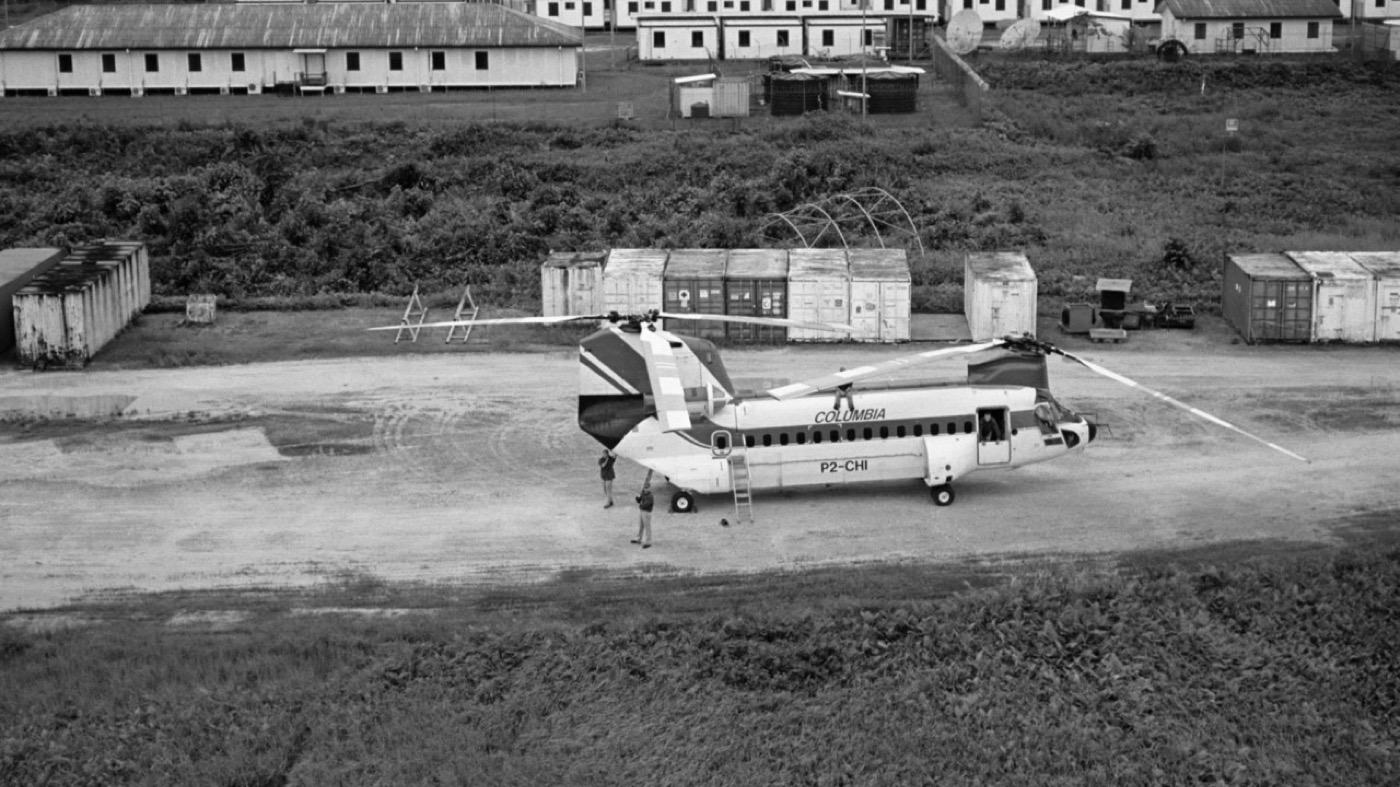
I had no real idea what Papua New Guinea would be like.
Flying over Lake Kutubu for the first time at the start of PNG LNG construction, I remember the contrast vividly. On one side, an unbroken canopy of rainforest. On the other, heavy machinery tearing into the mountain as ExxonMobil began one of the most ambitious engineering and logistics projects in the world, laying hundreds of kilometres of pipeline through terrain that defeats roads, bridges and sometimes aircraft.
PNG’s oil story did not begin with LNG. It began more than 30 years earlier with a bold bet in the Highlands that looked, by 2003, like a failure.
Chevron’s Billion Dollar Gamble
Chevron discovered commercial oil at Kutubu in 1986. Developing it was an engineering achievement few outside PNG fully appreciate. Processing facilities were built at 2,000 metres elevation. A 265 km pipeline crossed mountains and flooded rivers to a marine terminal in the Gulf of Papua. Helicopters were necessities, not luxuries.
First oil flowed in 1992. By 1993, production peaked near 130,000 barrels per day, accounting for around 28% of PNG’s total exports.
Then decline came quickly. The aquifer expected to maintain reservoir pressure did not behave as modelled. By 2001, production had halved in 3 years. Forecasts pointed to economic limit by 2006. The field looked finished.
In April 2003, ChevronTexaco announced it would sell its PNG interests. For a global major rationalising its portfolio, it was a logical decision. For PNG, it felt like the end of an era.
Then a white knight arrived.
The Hero
Oil Search stepped in and acquired Chevron’s entire PNG portfolio for US$96.6 million.
Founded in 1929 and embedded in the country for over 7 decades, they were unlike any external operator. They spoke Tok Pisin. They understood clan structures and historical grievances.
During PNG LNG construction I saw firsthand what that meant in practice. Frustrated landowners shut down infrastructure overnight. Disputes escalated into something uglier than boardroom arguments. Kidnappings happened.
An 88% Papua New Guinean workforce was not a branding exercise. It was operational survival.
And they did something even more important. They went back to the data.
Oil Search’s reservoir engineers challenged the model Chevron had left behind. The prevailing interpretation assumed a connected reservoir with active aquifer support and a slanted oil water contact. The new team saw something different. The reservoir was compartmentalised, divided by faults that severely limited communication between sections. What had been read as dynamic aquifer movement was better explained by perched water in isolated fault blocks.
That single conceptual shift unlocked a development campaign that targeted compartments the original model had written off entirely. Infill wells encountered strong oil saturation with minimal water production. Over 4 years, decline was not just slowed. It was halted. A field forecast to reach economic limit by 2006 was producing into the 2030s. The licence was extended to December 2035. Roughly 96% of its reserves were ultimately recovered across 4 decades.
Then the gas added a chapter nobody had priced. For over 20 years, associated gas from Kutubu had been reinjected underground for pressure maintenance. Up to 400 MMcf/d cycled back into the reservoirs because there was no market. Gas was never included in the Chevron sale price. When PNG LNG commenced in 2014, that same gas became feedstock supplying roughly 20% of the project’s total volume. Value that had always been there, waiting for infrastructure and timing to release it.
Oil Search breathed new life into dying fields, carried PNG into the LNG era, and did it with genuine operational commitment and engineering innovation to the country they had spent decades in.
Yet every white knight has a dark story.
The Merger That Made It Possible
Oil Search did not arrive at that US$96.6 million acquisition through its own accumulated strength. The financing required a transaction that remains controversial in PNG to this day.
In April 2002, just before a national election, Oil Search merged with Orogen Minerals Limited. Orogen was PNG incorporated and held a 20% stake in the Porgera Gold Mine, one of the country’s most valuable mineral assets, along with oil interests. Through the MRDC, PNG citizens effectively owned 51% of Orogen.
At the time of the merger, Oil Search’s most prominent asset was a 37% theoretical interest in a proposed gas pipeline to Queensland that was never built. Through the A$1.4 billion merger, Orogen shareholders received around 34% of the enlarged Oil Search. PNG’s effective majority in Orogen became an 18.1% stake in Oil Search. The existing 15% cap on non-government shareholding was removed to allow it.
PNG mineral wealth was converted into private control of the country’s oil sector. Eighteen months later, Oil Search sold Orogen’s Porgera stake for US$73.8 million and used those proceeds to partially finance the Chevron acquisition. PNG’s gold paid for PNG’s oil fields. The net financing required was relatively modest.
It was exploitation of political timing dressed as capital allocation. PNG went from majority owner of its own mineral assets to minority shareholder in the company that now controlled them.
The Second Dark Chapter
The story did not end there. In 2014, PNG Prime Minister borrowed A$1.24 billion from UBS to purchase Oil Search shares on behalf of the state.
Consider what that moment represented. PNG was borrowing at premium prices, accumulating sovereign debt, to buy back a stake in a company that had been built substantially from PNG’s own assets through the Orogen merger 12 years earlier. The state was paying to reacquire diluted ownership in an entity that owed its existence partly to the conversion of PNG’s minerals into private equity.
The UBS loan became one of the most damaging financial decisions in PNG’s recent history.
The proceeds from that purchase were used to fund Oil Search’s entry into the Elk/Antelope gas project, now known as Papuan LNG. The same blueprint deployed twice. PNG’s assets converted into corporate position, then PNG borrowing to chase ownership in the result.
The Lesson
Kutubu was forecast to close by 2006. It produced into the 2030s. The reservoir held more than the original model suggested. The gas held value long before a market existed. Neither would have mattered without the technical courage to challenge accepted conclusions and the operational commitment to see it through.
Oil Search was genuinely exceptional at both. The reservoir rethink was brilliant. The community relationships were real. The field’s resurrection stands as one of the more remarkable turnarounds in regional petroleum history.
But the capital structure that made it possible was built on a controversial merger, followed by a billion dollar government loan to repurchase what PNG had given away.
White knights rescue the assets.
They do not always rescue the kingdom.