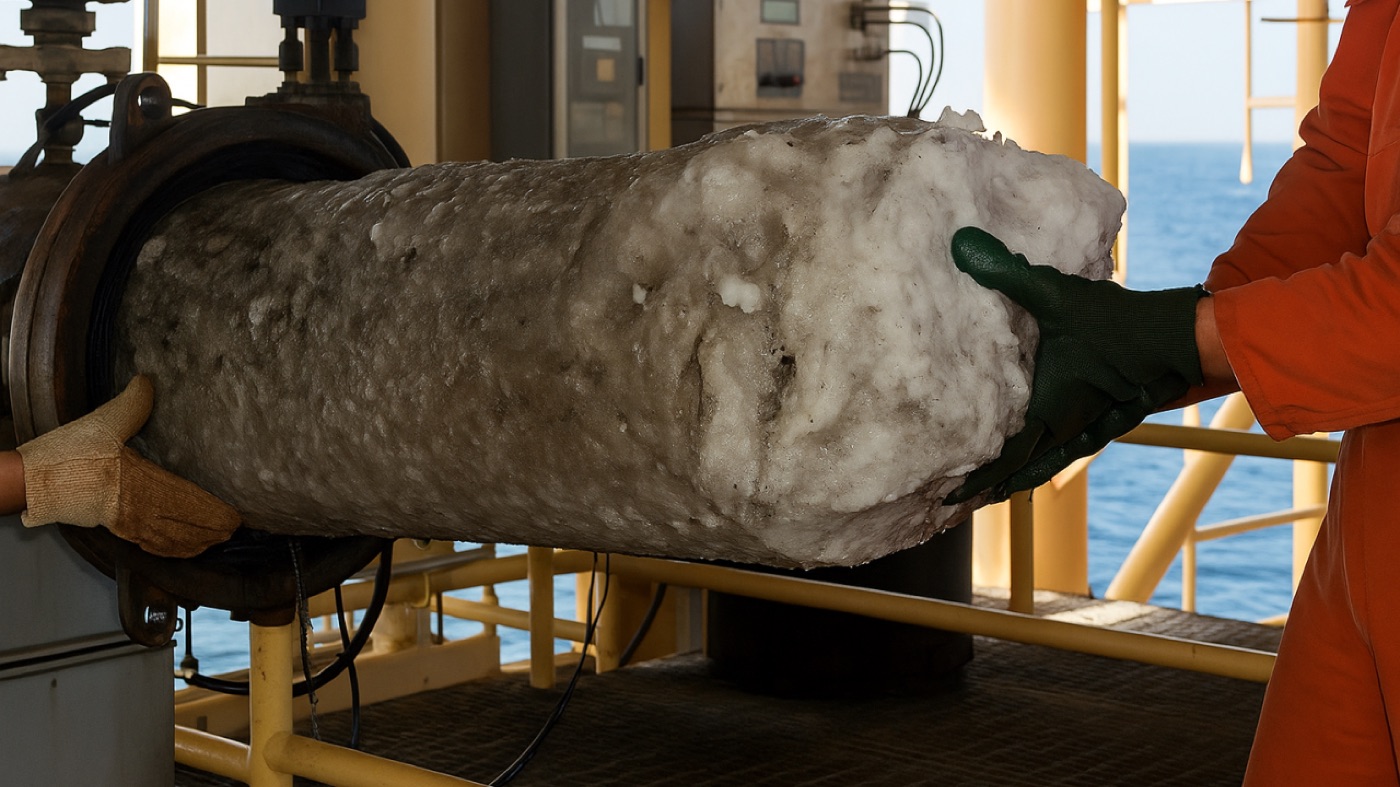
Production and flow assurance engineers frequently battle natural gas hydrates, crystal structures that can form troublesome blockages in oil and gas pipelines. Unlike ordinary ice, gas hydrates trap hydrocarbon gases within a cage-like structure formed by water molecules. Hydrate formation requires four critical factors:
- Water: In the form of liquid or vapor.
- Hydrocarbon Gas: Typically methane, ethane, CO₂, or H₂S, trapped inside water cages.
- High Pressure: Keeps gas in close contact with water.
- Low Temperature: Stabilises hydrate structures, typically under 20°C in high-pressure scenarios.
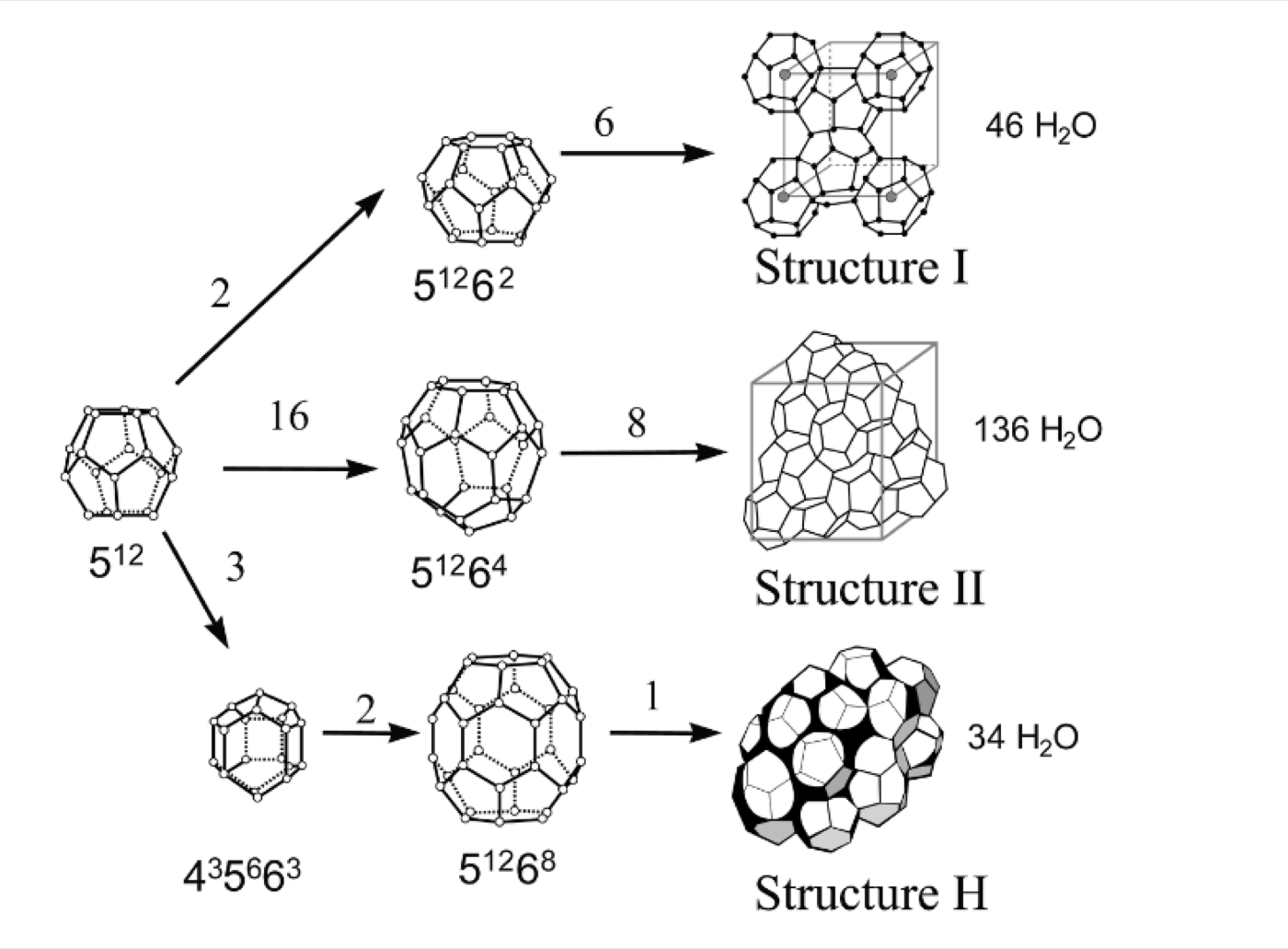
Common natural gas hydrates, adapted from Sloan (2011, p. 3)
Effective hydrate management begins with a deep understanding of how they form, how to predict their occurrence, and the most effective and economical prevention strategies.
Predicting Hydrate Formation in Different Systems
Hydrate prediction starts with thermodynamic modeling, which determines the pressure and temperature conditions at which hydrates are stable. This typically involves tools like PVTSim, MultiFlash, or CSMGem, which use models such as van der Waals–Platteeuw (1959) to calculate hydrate equilibrium curves.
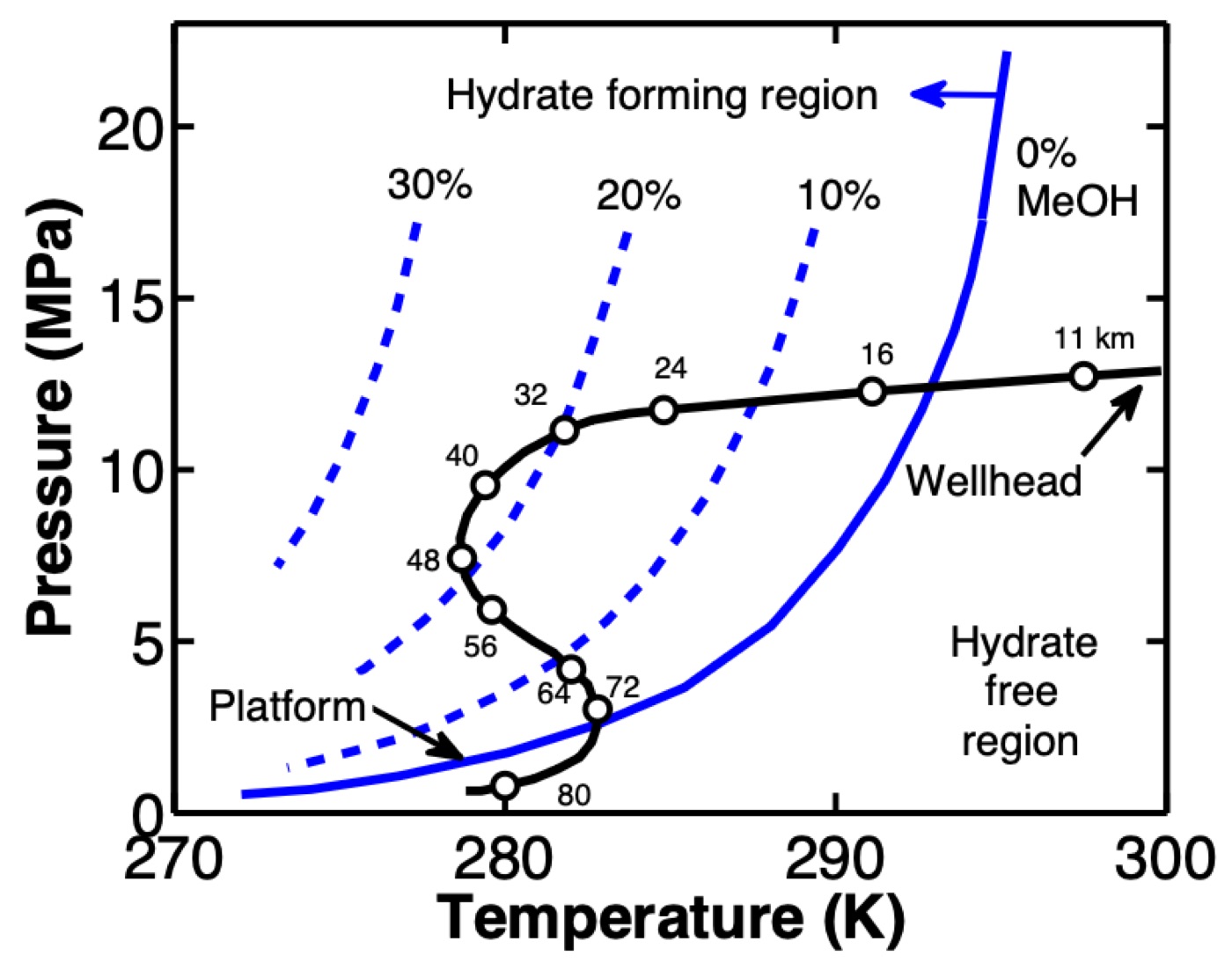
Pressure Temperature diagram showing hydrate equilibrium curves at different methanol concentrations, adapted from Sloan and Koh (2011, p.646)
However, prediction becomes more complex in multiphase systems where flow regimes and phase interactions significantly affect hydrate risk. The type of dominant phase — oil, water, or gas — changes the hydrate formation and transport behaviour:
- Oil-Dominated Systems: In these systems, hydrates form around water droplets dispersed in the oil. Predictive models must account for emulsion stability, water cut, and droplet interactions. Advanced simulations consider how hydrate particles agglomerate and interact with the oil phase, influencing plugging risk.
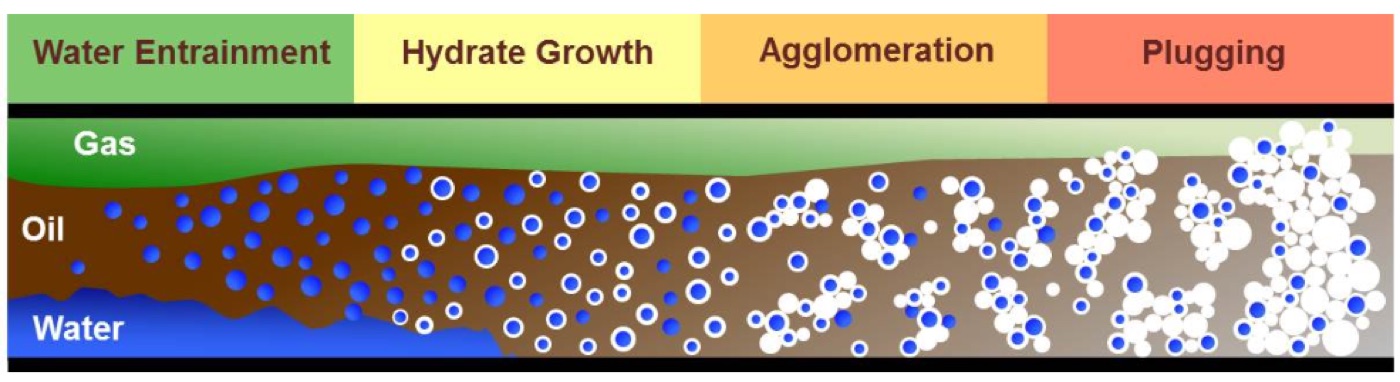
Hydrate formation in oil-dominated systems, adapted from Turner (2005)
- Water-Dominated Systems: Here, hydrates tend to form more uniformly due to the abundance of continuous water. These systems often exhibit higher plugging risks at lower hydrate fractions. Modelling focuses on flow transitions and slurry behaviour as hydrates accumulate.
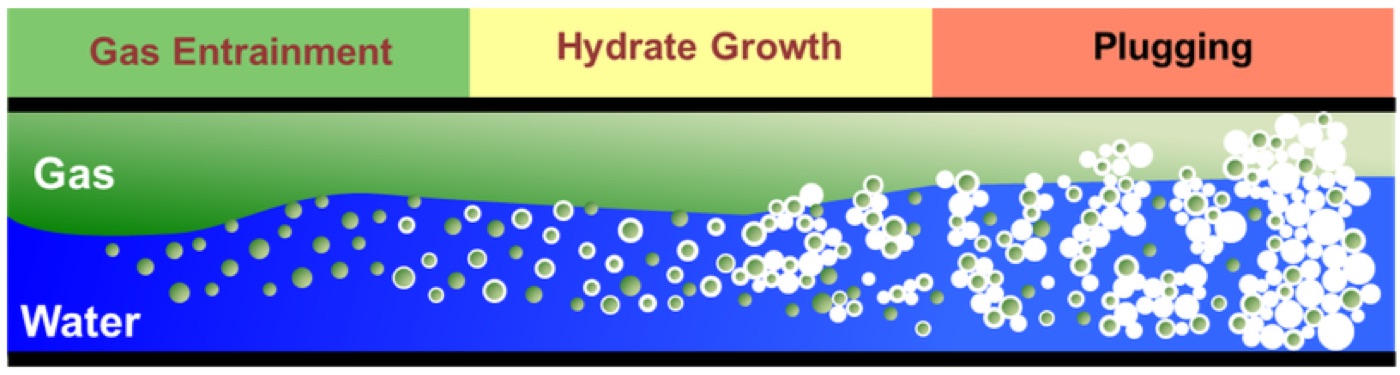
Hydrate formation in water-dominated systems
- Gas-Dominated Systems: Hydrate film growth is a critical concern, as hydrates form on pipe walls from gas saturated with water. Predictive tools must model film development and transport under low liquid loading, capturing how minor changes in temperature or gas composition trigger hydrate growth.
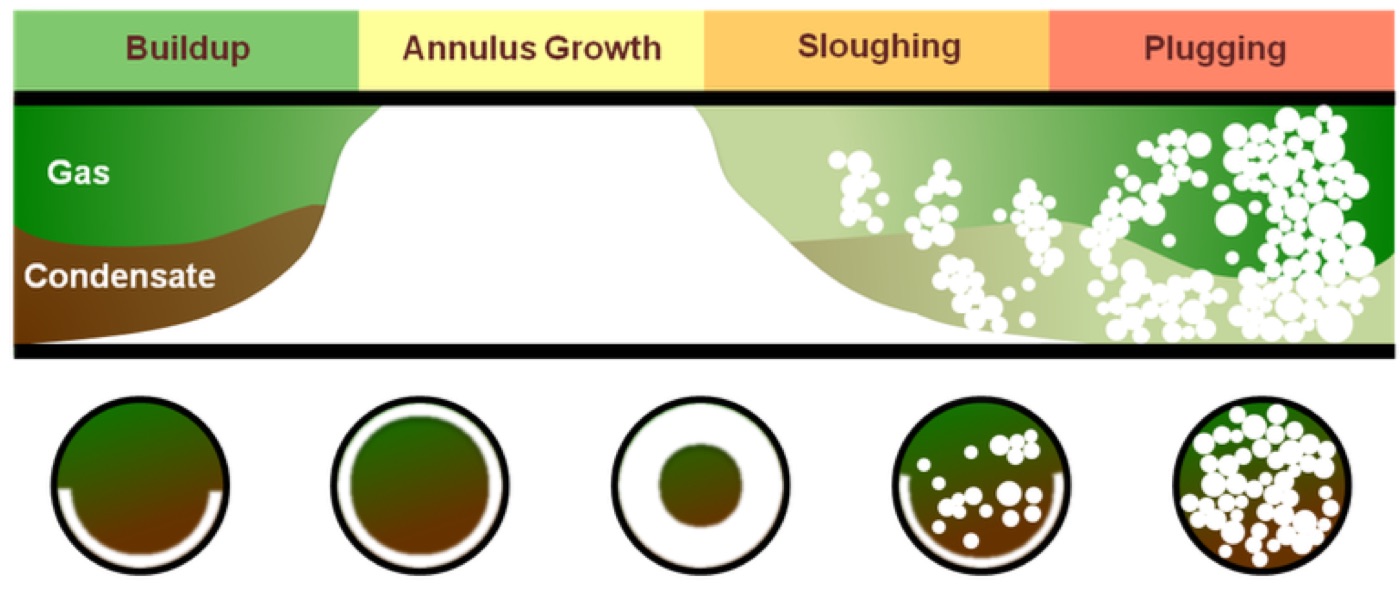
Hydrate formation in gas-dominated systems, adapted from Lingelem et al. (1994)
These tailored models integrate with transient multiphase simulators to support design and operational decisions, especially for shutdown and restart scenarios.
Ice vs. Hydrate Formation Below Freezing
An interesting question arises when operating below 0°C: Is ice or hydrate formation more dominant?
Both ice and hydrate can form directly from water vapor via deposition (for ice) or hydrate deposition (for hydrates). They compete for the same water molecules.
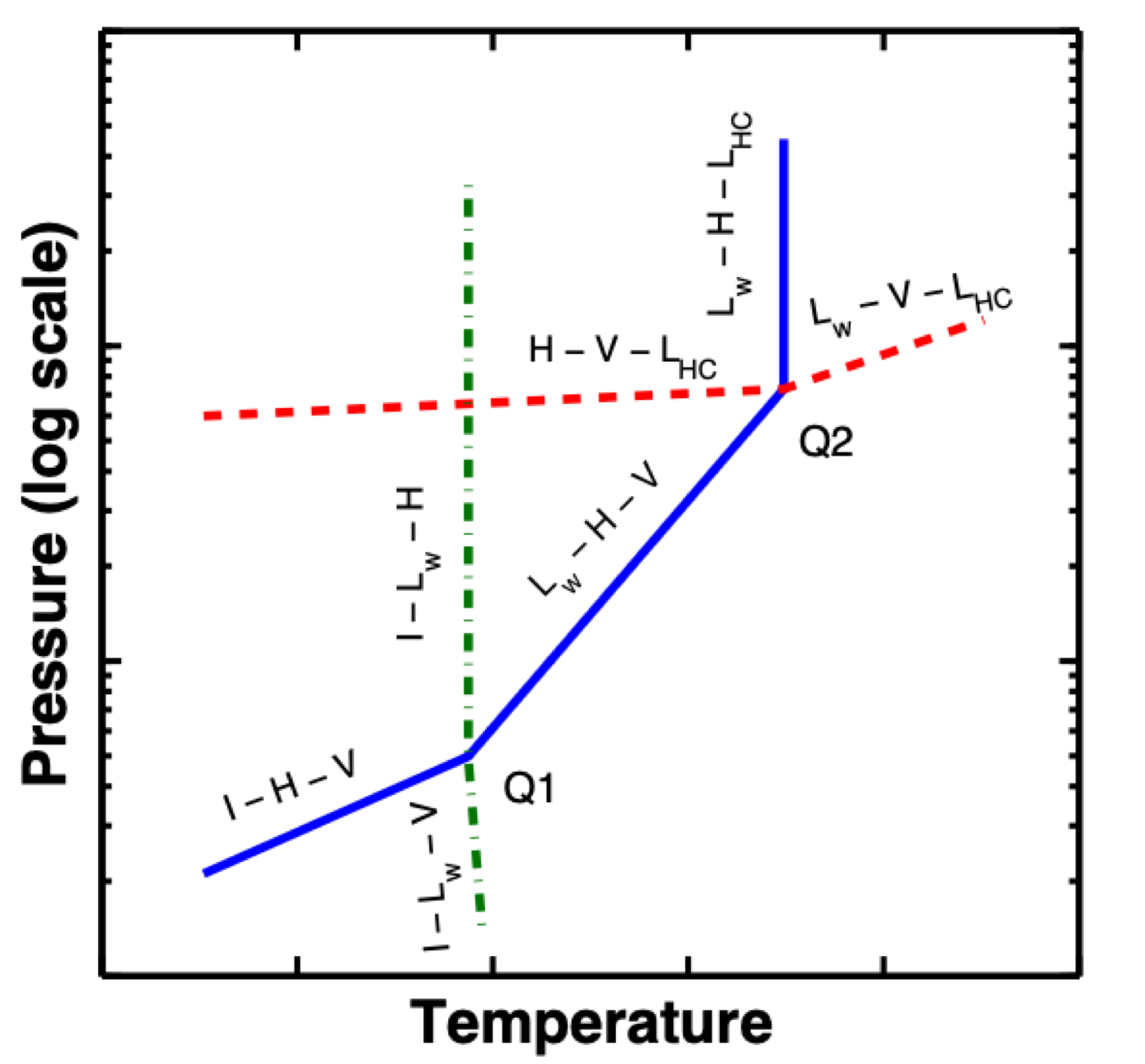
P-T digram for hydrocarbon-water system. I - Ice, H - Hydrate, V - Water Vapour, Lw - Water Liquid, adapted from Sloan and Koh (2011, p.198)
Both processes are exothermic:
- Ice formation releases latent heat (approx. 334 J/g).
- Hydrate formation releases even more heat (approx. 410–430 kJ/kg).
Given hydrate’s higher exothermic heat release, it can locally increase temperatures and delay ice formation. Additionally, in gas-rich environments, hydrates may form more readily and rapidly consume available water vapor. Therefore, under high-pressure, gas-saturated conditions typical in pipelines, hydrate formation dominates below freezing, making it the primary risk.
Hydrate Plug Prevention
Traditionally, hydrate management involved complete avoidance by staying outside the hydrate stability zone. This meant injecting thermodynamic inhibitors like methanol or MEG, dehydrating gas, or maintaining appropriate temperature and pressure.
However, avoidance can be uneconomical or impractical, especially for long-distance subsea operations. Modern risk management allows hydrates to form but prevents their agglomeration into plugs:
- Kinetic Hydrate Inhibitors (KHIs): Delay hydrate formation with low dosages, effective for short exposure times. Unsuitable for long shutdown.
- Anti-Agglomerants (AAs): Allow hydrates to form as dispersed, non-blocking slurry particles in oil-rich systems, also at low dosages.
Selecting the right inhibitor depends on operational scenarios, economics, and environmental considerations, often leading to combined inhibitor strategies.
Emerging Research: Cold Flow and Next-Gen Strategies
Recent innovations like cold flow technology, developed by ExxonMobil and SINTEF Petroleum Research, propose a different strategy: encourage rapid hydrate formation under controlled conditions. Without free water to generate capillary forces, hydrates stay as dispersed slurries that can be transported without blocking flowlines. Advantages include reduced chemical usage, less insulation, and simplified operation. Ongoing field trials aim to scale this approach across various system types.
Other innovations include:
- Hydrate-repellent pipeline coatings.
- Real-time hydrate detection sensors.
- Hybrid inhibitors that combine kinetic delay and anti-agglomeration.
Summary
Hydrate management remains a critical yet evolving challenge in flow assurance. By understanding how hydrate risk varies across system types—oil-, water-, or gas-dominated—and by recognising hydrate’s dominance even below freezing, engineers can implement more cost-effective, reliable prevention methods.
Although this article focuses on prediction and prevention, it’s crucial to stress that all operations personnel should be trained in the safe handling and remediation of hydrate plugs, especially during decompression or depressurisation events.
References:
Sloan, D., Koh, C. and Sum, A.K. (2011). Natural Gas Hydrates in Flow Assurance. Gulf Professional Publishing.
Carroll, J. (2014). Natural Gas Hydrates: A Guide for Engineers. Gulf Professional Publishing.