In my last article on flow meters, we saw that each type has its own strengths and sweet spots across oil and gas. One thing is constant though: accurate measurement is everything. From production optimisation to allocation and fiscal transfer, measurement underpins not just how we manage reservoirs, but also how billions of dollars are accounted for across the value chain.
The Multiphase Flow Meter (MPFM) has long been positioned as a cost-effective alternative to the good ol’ test separator — and in some cases, it’s the only viable option.
The Test Separator – Trusted but Clunky
In many onshore and offshore operations, wells are tested periodically, often once a month. Production is diverted via a test line to a separator, where oil, gas and water are measured.
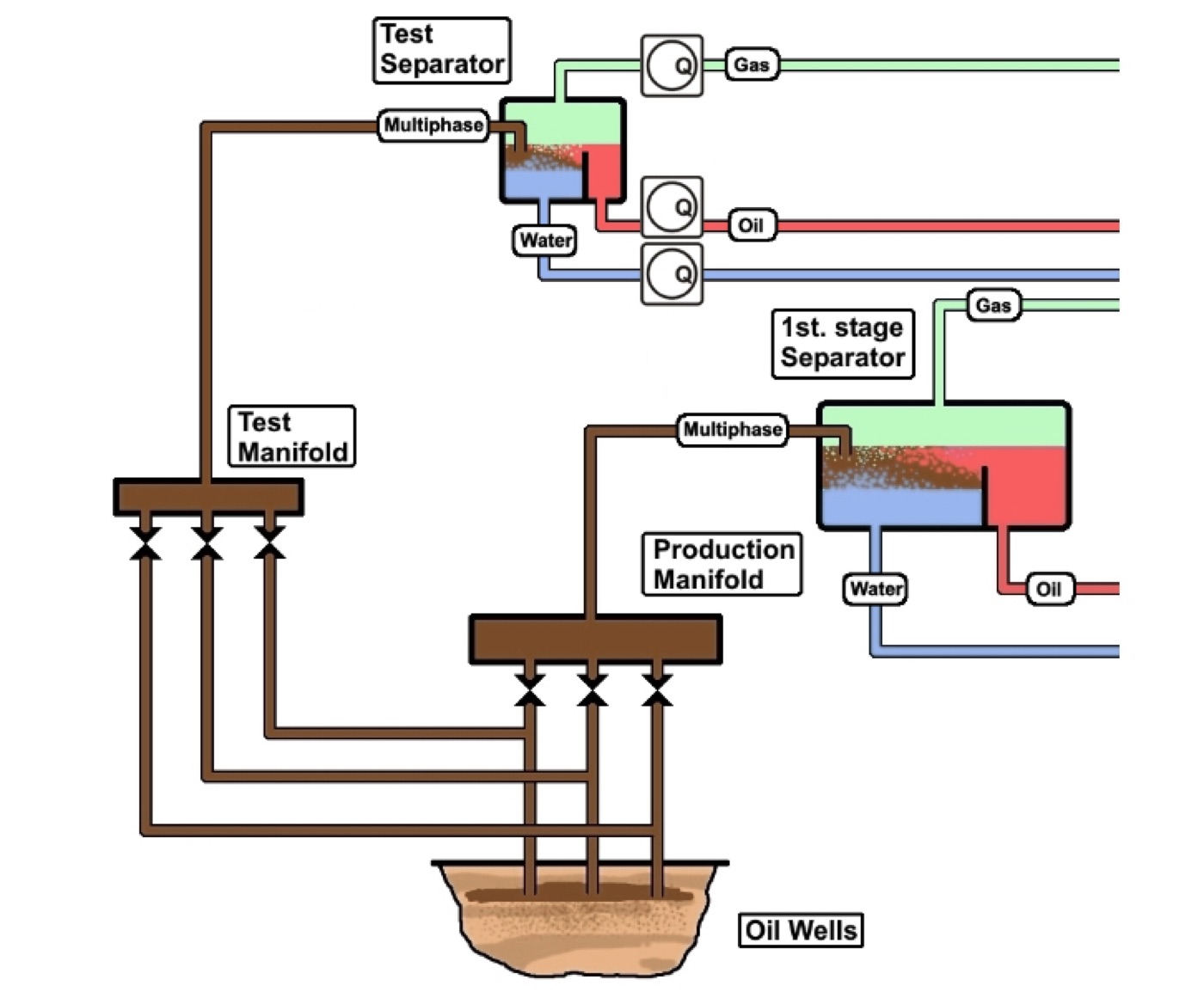
Sounds simple, but there are practical snags:
- Higher line pressure: Test lines are smaller, and that pressure drop can distort results.
- Shared lines: Wells often share a test line, meaning one or more wells must be shut in for a valid test.
- Test-by-difference: Used as a workaround, but it can introduce major uncertainty — and some regulators won’t accept it.
- Deferrals: Long purge times or well shut-ins for standalone tests mean lost production.
So while test separators provide direct, physical separation, they also bring cost, operational inflexibility, and deferred barrels.
How Do MPFMs Work?
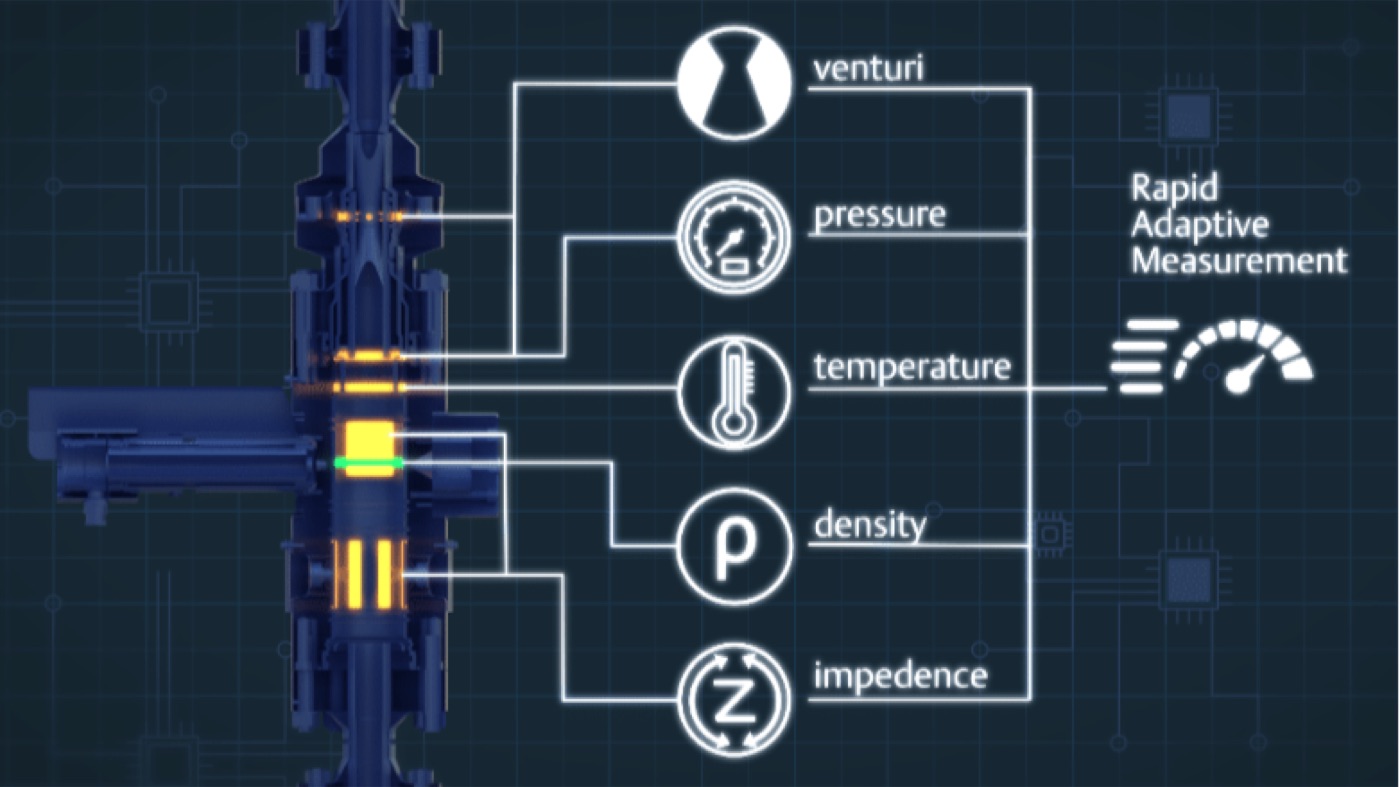
A MPFM doesn’t “see” oil, water, and gas as three neat layers like a separator. To determine volumetric flow rates for each phase, three key measurements are needed:
🔹 Velocities: Often measured via Venturi differential pressure, or cross-correlation between sensors placed at two points in the line .
🔹 Phase fractions: Determined using gamma-ray attenuation, microwave, or electrical impedance sensors .
🔹 Densities: Brought in via PVT data or compositional analysis .
Combine these and you get the holy grail: oil, water, and gas flow rates, continuously and in real time.
Flow Regimes and Slip Effects
Multiphase flow is messy. Different regimes (slug, annular, bubble, mist) generate very different sensor responses:
- In slug flow, sensors experience huge fluctuations that must be averaged carefully.
- In annular flow, thin liquid films and droplets can throw off gas velocity readings.
And then there’s slip. Gas almost always moves faster than liquid. That means liquid hold-up is greater than its volume fraction, so MPFMs must correct for slip. Ignore it, and systematic flow-related biases creep in (not just random error).
Gas Volume Fraction (GVF) is often used as a shorthand classification tool:
- The sweet spot for most MPFMs is 25%–85% GVF (NFOGM & TUV NEL, 2005).
- At GVF >95%, specialised wet gas meters are more appropriate.
Importantly, wells don’t stay in one regime. Reservoir depletion, rising water cut, and shifting GOR all change flow behaviour over time. An MPFM tuned for bubbly flow may stumble badly once the well goes slugging.
Main Categories of MPFMs
A. In-line meters
- Measure the flowing mixture directly.
- Use Venturi DP for total flow + gamma/impedance/microwave for fractions.
- Compact, subsea-friendly, but accuracy is highly regime-dependent.
B. Separation-type meters
- Provide some degree of in-meter separation before measurement.
- Can be full (gas/liquid split), partial (cyclonic), or in a bypass sample line.
- Generally bulkier, with maintenance needs, but can improve accuracy.
C. Wet gas meters
- For GVF >95%.
- Often Venturi-based with corrections for liquid presence.
- Widely used in gas condensate fields, but tiny liquid errors can create large allocation errors.
Performance Specification
Handbook of Multiphase Flow Metering (NFOGM & TUV NEL, 2005) stressed the need for standardised performance metrics. Key specifications include:
- Measuring range – The envelope where the meter can operate reliably.
- Rated vs limiting conditions – Normal vs extreme operating scenarios.
- Measurement uncertainty – The dispersion around a measured value.
- Repeatability and reproducibility – How consistent results are under the same or changed conditions.
The guideline emphasises that uncertainty must always be quantified and communicated, allowing operators to compare meters and make informed technology choices.
Design Guidelines
No MPFM can measure everything. That’s why design starts with matching the well’s production envelope (expected flow rates and fluid compositions) with the meter’s measuring envelope.
Two practical tools are used:
- Two-phase flow maps: Superficial gas vs liquid velocities.
- Composition maps: GVF vs water cut.
By overlaying well trajectories (how production changes over time) on these maps, engineers can ensure the MPFM remains within its reliable range throughout the field’s life.
Testing, Calibration and Adjustment
Unlike single-phase meters, MPFMs are harder to calibrate. Three critical steps:
- Factory Acceptance Testing (FAT): Manufacturer site verification.
- Calibration: Relating measured signals to reference standards.
- Adjustment: Tuning if the meter drifts.
Since true multiphase calibration facilities are rare, in-field calibration often relies on comparison with test separators, tracer methods, or reconciliation against reference data.
Field Installation & Commissioning
Even the best MPFM will underperform if poorly installed. Consider:
- Pipe geometry — bends, valves and slugging affect readings.
- Integration — tie-in with control systems and historians.
- Commissioning — stepwise startup and baselining before continuous ops.
For subsea, retrieval is costly, so robust design and reliability are non-negotiable.
Verification During Operation
Since MPFMs can’t be shipped back for calibration, verification must happen in the field:
- Baseline trend monitoring.
- Built-in self-diagnostics.
- Twin meters in series (cross-check).
- Tracer injection methods.
- Sampling & reconciliation.
- Geochemical fingerprinting.
The aim: maintain confidence in data over the well’s life.
Key Takeaways
- Flow is complex. Regimes and slip effects dominate MPFM design and performance.
- Specify performance. Uncertainty and range define the meter’s usefulness.
- Design with envelopes. Match well trajectories to meter capability.
- Calibration is hard. Hybrid approaches are the norm.
- Installation counts. Especially subsea, where mistakes cost millions.
- Verification is continuous. Without it, confidence evaporates.
Final Thoughts
MPFMs have transformed how we test and allocate production, especially in subsea and remote operations. But they’re not a set-and-forget gadget. Success comes from disciplined engineering and collaboration across instrumentation, production, reservoir and PVT.
Reference:
NFOGM & TUV NEL (2005) Handbook of Multiphase Flow Metering. 2nd rev. Oslo: Norwegian Society for Oil and Gas Measurement (NFOGM) and TUV NEL Ltd. ISBN 82-91341-89-3.