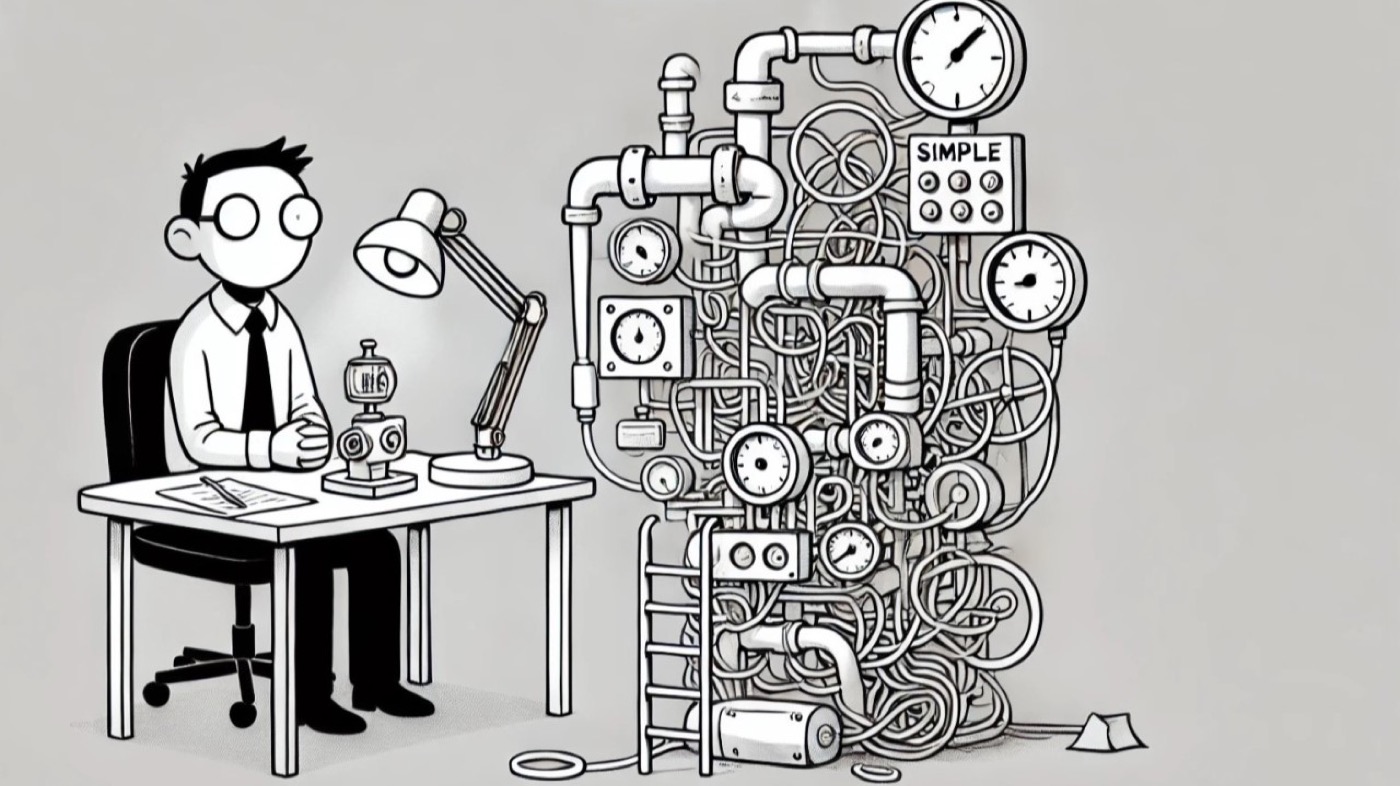
In engineering, we love simplicity. A clean, elegant solution that just works, especially in a messy and complex world, feels like magic. But here’s the kicker: getting to that level of simplicity takes deep thinking, years of experience, and usually, a few coffee-fuelled debates with the team.
This is the essence of the KISS principle, “Keep It Simple, Stupid”, originally coined by the U.S. Navy in the 1960s. It wasn’t advocating for dumbing things down. it wasn’t meant to insult anyone’s intelligence. It was a reminder not to make things more complicated than they need to be.
But in oil and gas? Well… sometimes we miss the memo.
🚨 When KISS Goes Off the Rails
We’ve all been there: you start with a nice, neat model. Life is good. But then it doesn’t quite handle everything. So, we add a variable. Then an adjustment. Then a lookup table. Then three macros and a Monte Carlo simulation for good measure.
Before you know it, your “simple” solution now requires a user manual, a troubleshooting guide, and possibly a dedicated team to maintain it.
Take production forecasting. A basic Decline Curve Analysis (DCA) can beat a full-blown reservoir model for short-term predictions with way less data, fewer assumptions, and about 1/10th the headache. But the moment DCA doesn’t behave, we panic and start building the forecasting equivalent of Frankenstein’s monster.
And the irony: the more complexity we add, the more assumptions we introduce, most of which are based on “gut feel” or whatever data we could scrape off a dusty spreadsheet from the last century.
This is how engineers accidentally create beautifully complex models that are less accurate, harder to explain, and way more expensive to maintain.
So Where’s the Sweet Spot?
That, my friends, is the eternal question. It’s not a formula, it’s a judgment call. And that judgment comes from a blend of:
- Technical depth: so you actually understand what matters (and what doesn’t).,
- Experience: both the kind that teaches you what works, and the kind that teaches you what *definitely doesn’t,*and
- Business sense: so the solution does what it’s meant to do, not just what’s technically possible.
Sometimes, what looks like oversimplification is actually a strategic trade-off, or smart prioritisation as I was told once.
I recently shared a Inflow Performance Relationship (IPR) tool for CSG wells. Some might wonder “Where’s the VLP curve? Where’s the NODAL analysis?”
But here’s the thing: we consciously decided to omit VLP for a reason. In CSG wells with dual flow paths and downhole separation, the assumption of mass conservation (which underpins NODAL) may not hold true. Adding complexity there would have introduced error, not removed it.
Adding complexity just to look smart? That’s not engineering, that’s theatre.
Final Thoughts
The right level of simplicity doesn’t come from ignoring complexity, it comes from understanding it deeply and then distilling it down to what matters most. KISS is not a shortcut. It’s the outcome of thoughtful design, guided by expertise, collaboration, and practical business goals.
So the next time someone says “keep it simple” don’t just think “keep it easy.” Think strategic. Think fit-for-purpose. And remember: true simplicity is hard-earned.
#PetroleumEngineering #CSG #DecisionMaking #DigitalOilfield #Overengineering #EngineerLife #EngineeringSimplicity