One Phrase, Different Meanings and Why It Keeps Causing Bad Decisions
I once watched a room full of engineers debate liquid loading for forty minutes before realising three different people meant three different things by “critical velocity.”
The well was still loading. The meeting achieved nothing.
In oil and gas, few terms create as much unintentional confusion. I’ve heard the same phrase used confidently to mean five completely different things, sometimes in the same conversation.
The result? Engineers talk past each other. Operating limits are misunderstood. Wells are overproduced, underproduced, or misdiagnosed.
This article does two things:
Maps out what “critical velocity” actually means across contexts, and zooms in on the most misunderstood case, critical lift velocity in gas wells, including an often overlooked question: can dry gas really lift sand?
”Critical velocity” is not one concept
The first problem is linguistic, not technical.
In practice, critical velocity is shorthand for “the minimum or maximum condition that prevents an undesirable failure mode.”
The key word is failure mode, because that changes by domain.
Same words. Completely different physics.
The four meanings engineers mix up
1. Reservoir and Inflow: Critical production rate for coning or cusping
This is the maximum rate below which the gas/oil or water/oil contact remains stable. Viscous drawdown pulls fluids toward the well. Gravity tries to keep them segregated. Produce above this rate and water or gas cones into perforations.
This is a reservoir stability problem, not a velocity problem.
2. Wellbore and Production: Critical lift velocity
This is where confusion explodes, because there are two different “critical velocity” here.
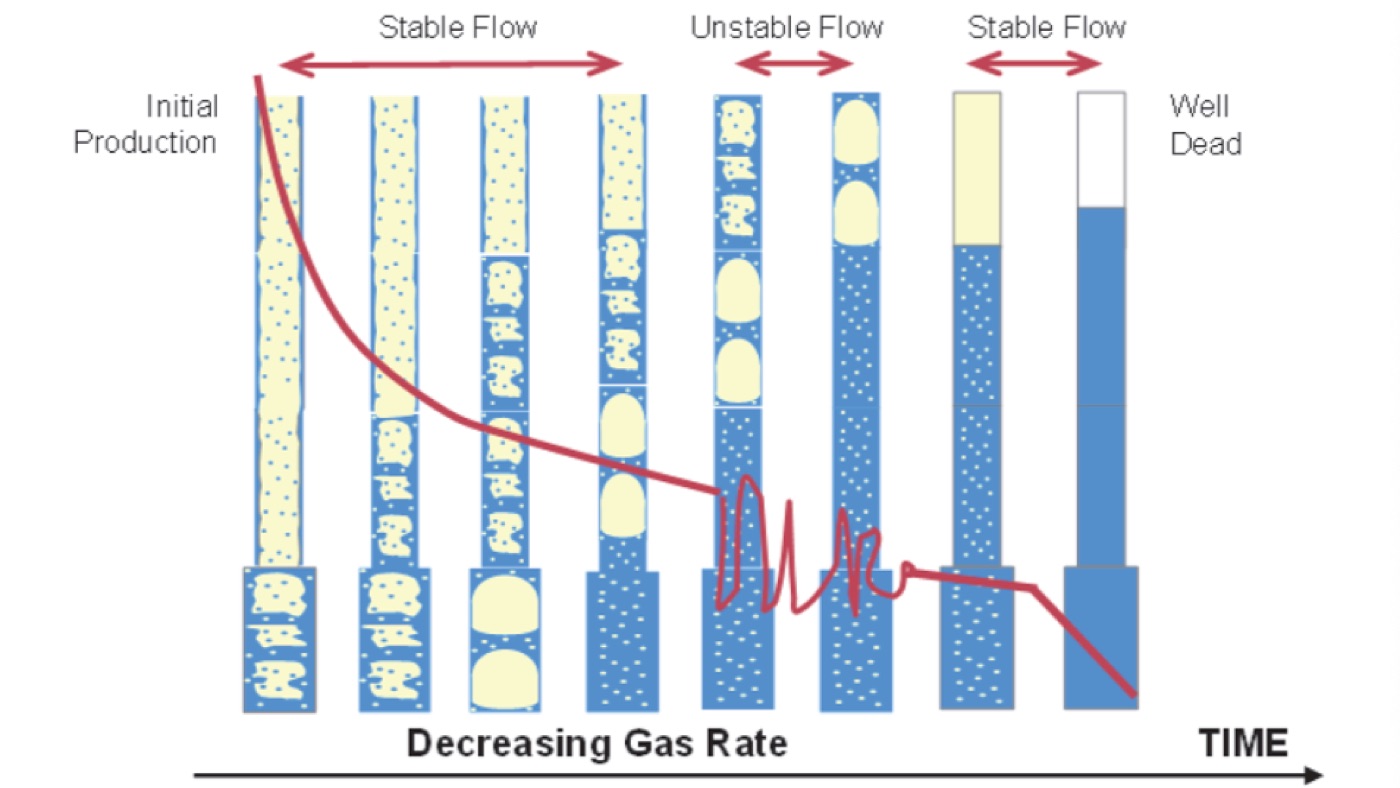
Critical liquid lifting velocity is the minimum gas velocity required to transport liquid upward. Used to assess liquid loading risk in gas wells.
Critical solid lifting velocity is the minimum liquid (and theoretically gas) velocity needed to keep sand particles mobilised. Closely related to sand deposition velocity, but with different geometry and flow regimes.
Same phrase. Two different transport problems.
3. Chokes and Valves: Critical (choked) flow rate
Flow reaches sonic conditions. Rate becomes independent of downstream pressure.
This is a compressible flow limitation, not a transport threshold.
4. Pipelines and Flow Assurance: Critical sand deposition velocity
Minimum velocity required to prevent stationary sand beds. A solids transport and regime transition problem. Widely used for flowline and pipeline design.
The Summary Problem
We use the same words to describe reservoir stability, multiphase transport, compressible flow limits, and solids deposition. No wonder meetings go sideways.
Critical lift velocity in wells: what does “lift” actually require?
For any phase, whether liquid droplets or solids, to move upward, one of two mechanisms must exist.
Continuous drag dominance, where upward drag force exceeds downward gravity at all times.
Or intermittent capture mechanisms, where the phase enters flow structures like films, slugs, or eddies that carry it upward before it can fall back.
If neither exists, lift will not happen, regardless of what a correlation says.
Liquid lifting in gas wells: why “critical velocity” isn’t universal
Most engineers think of liquid unloading as droplet transport. Can gas drag overcome gravity acting on droplets?
That works reasonably well for vertical wells, high GOR, and mist or annular flow.
But real wells rarely stay that simple.
In practice, liquid is lifted by wall films driven by gas shear, slugs acting as intermittent elevators, and re-entrainment after fallback.
That’s why wells can meet “critical velocity” and still load. That’s why deviated wells load earlier than vertical ones. That’s why liquid rate matters almost as much as gas rate.
Critical velocity is regime dependent, not a single number.
Now the tricky part: lifting sand
In liquid dominant systems, sand is carried as a slurry. Transport depends on turbulence, particle size, and bed shear. “Critical velocity” is statistical, not absolute. There is no single threshold because sand size is a distribution, not a number.
In gas dominant systems, this is where mistakes happen.
Gas is a poor lifting medium for solids. Low density. Low momentum. High particle slip velocity.
In gas wells, liquid is the real sand carrier. Sand rides in films, slugs, or liquid rich zones.
Here’s the key rule: if liquid isn’t lifted, sand won’t be lifted.
Dry gas may lift very fine dust, but for real sand sized particles there is no robust “critical velocity.” Transport becomes probabilistic and unreliable. Settling occurs even when surface rates look healthy.
This is why sand problems often appear before liquid loading, and why they suddenly spike after small liquid rates appear.
The most dangerous sentence in production meetings
“We’re above critical velocity.”
The only correct response is:
“Critical for what failure mode?”
Liquid loading? Sand deposition? Coning or Cusping? Choked flow?
If that isn’t clear, you’re not having the same conversation.
Final takeaway
“Critical velocity” is not a law of nature. It’s a context dependent boundary tied to a specific failure mode.
When we forget that, we stop doing physics and start repeating slogans.