You’re staring at the RFT/MDT plot, thrilled to see the oil gradient lining up beautifully—clear evidence all your wells are connected. Then suddenly, the water gradient spoils the party, appearing above the established oil-water contact (OWC) with a confusingly different pressure regime. Doubt creeps in: are your reservoirs actually compartmentalised?
Maybe you’ve even gone to extremes, checking oil biomarkers or isotopes. After all, pressures might deceive, but molecules don’t.
🧪 The Art (and Madness) of Reading RFT/MDT Pressure Data
Reservoir engineers live and die by pressure gradients. Properly interpreted RFT/MDT data doesn’t merely indicate “what’s where”, it whispers deeper secrets about fluid connectivity, trap integrity, and the reservoir’s fluid migration history.
But why would a water-saturated zone appear above a known OWC, showing clear oil communication but pressure offsets in the water leg?
📚 Hubbert’s Legacy: The Hydrodynamic Puzzle
Back in the mid-20th century, M. King Hubbert introduced a provocative theory: hydrodynamic tilting. Water in motion can tilt the oil-water contact, pushing hydrocarbons uphill due to pressure head from flowing water, not just buoyancy.
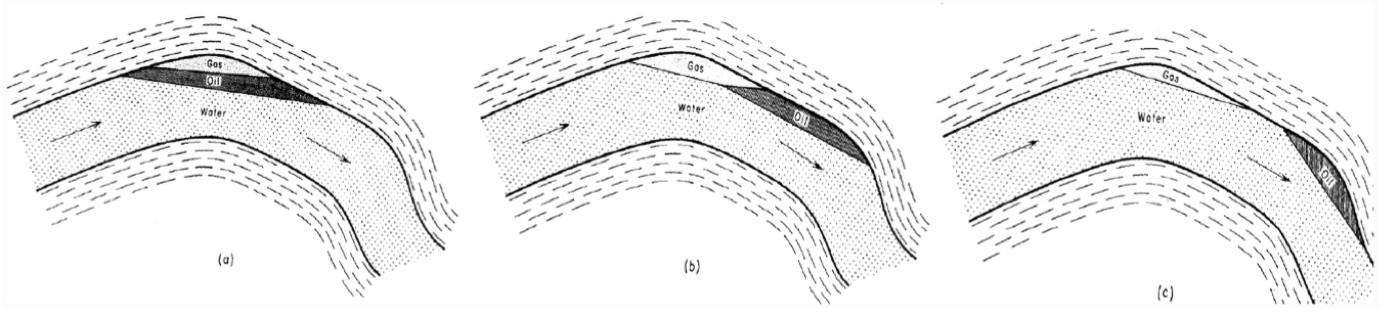
After Hubbert (1953), AAPG Bulletin Vol. 37(8).
It’s elegant, clever and sometimes dangerously convincing. After all, a tilted contact explains a lot. But here’s the kicker: in many modern cases, the required lateral flow volume would have had to persist… for millions of years. Without any consistent source or sink. Without changing salinity. Without leaving a single geological breadcrumb.
It’s like assuming a leaky bathtub has been dripping since the Cretaceous. Possible? Perhaps.
💧Perched Water: A Counterintuitive Phenomenon
In the realm of conventional oil and gas exploration, perched water is a phenomenon so counterintuitive it often masquerades as error, noise, or even failure. Yet, when understood, it offers profound implications for field development, hydrocarbon estimation, and well placement strategies.
📍What Causes Perched Water?
Hydrocarbons migrating laterally through depositional fairways (such as turbidite channels or fans) can encounter subtle barriers:
- Lateral facies changes (tighter formations)
- Structural saddles or pinchouts
- Channel margins or subtle stratigraphic highs
These barriers trap formation water above the main aquifer, creating isolated pockets of perched water. Continued hydrocarbon migration downdip then creates the puzzling scenario of hydrocarbons trapped beneath a pressurized water zone.
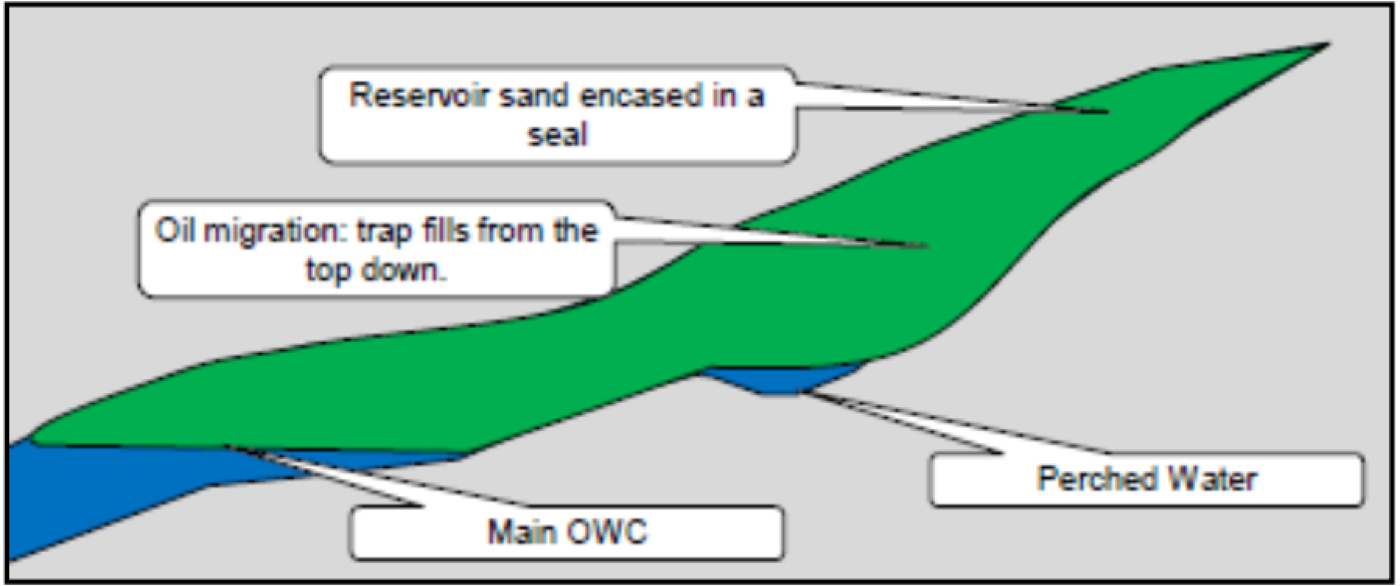
After Lee M and Clechenko C (2018)
🔍 Clues from Production Data
When seismic and log data are ambiguous and RFT readings present riddles, production behaviour becomes your secret decoder. A prime example is Alpha Field (West Africa, SPE-196635-MS): initial water cuts of 10–20% decreased or stabilized over time, exactly opposite of a connected aquifer scenario. This strongly suggested perched water. Subsequent 3D reservoir simulations and tracer studies confirmed it, a classic perched water case.
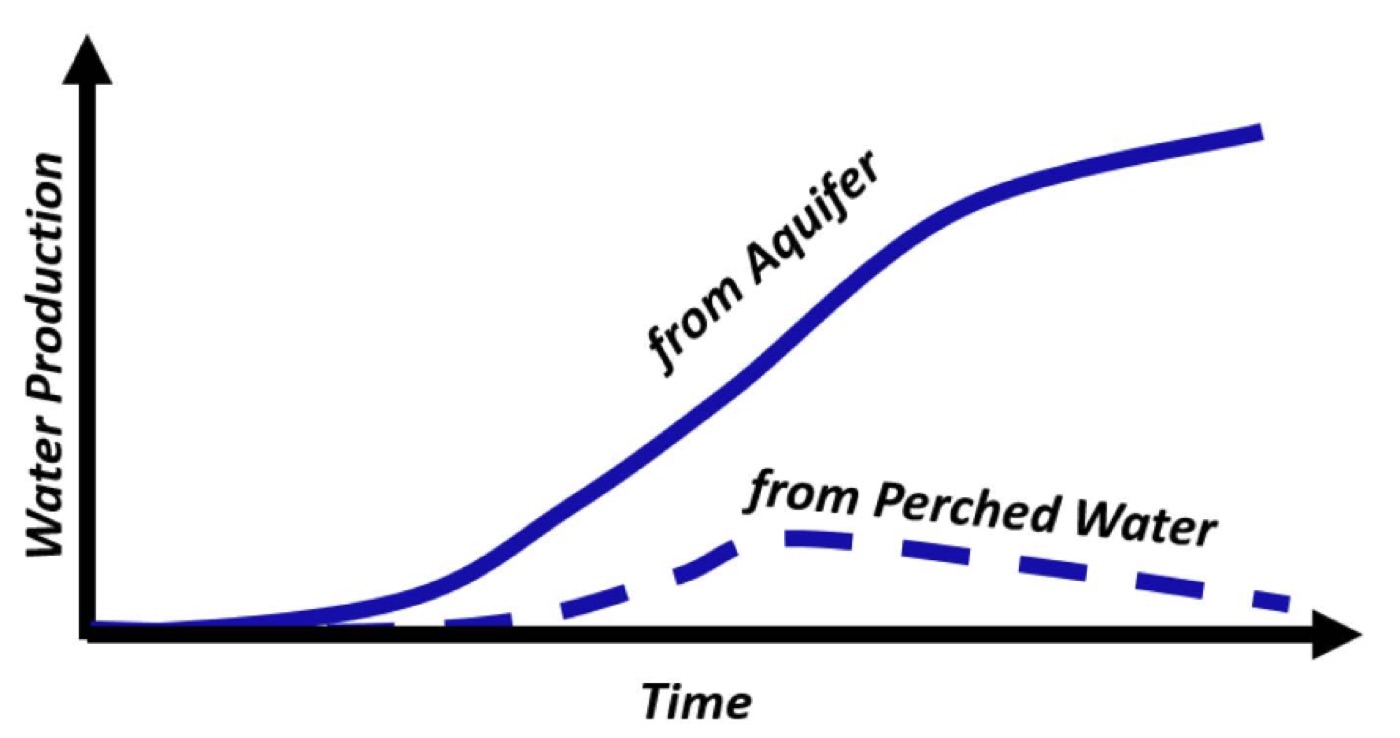
Expected Water Production from Aquifer vs. Perched Water (Adapted from Macaluso, D. et al, 2019)
Key insight: A declining or stable water cut from the outset likely indicates perched water rather than aquifer breakthrough.
💡 Remember: Perched water isn’t an error. It’s a geological narrative revealing how traps filled, what impeded water flow, and where hydrocarbons ultimately accumulated.
Have you encountered perched water in your reservoirs? I’d love to hear your experiences!
📚References
- Macaluso, D., Colombi, N., Castelnuovo, L., Calderoni, M., & Prevosti, P. (2019). Perched Water – Identification and Production Behavior in a Real Case. SPE-196635-MS. Presented at the SPE Reservoir Characterisation and Simulation Conference and Exhibition, Abu Dhabi, UAE.
- Rolfsvåg, T. A., & Danielsen, T. M. (2016). Perched Water Static Model. SPE-180000-MS. Presented at the SPE Bergen One Day Seminar, Bergen, Norway.
- Gaafar, G. R., Altunbay, M. M., & Aziz, S. B. A. (2016). Perched-Water: The Concept and Its Effects on Exploration and Field Development Plans in Sandstone and Carbonate Reservoirs. OTC-26653-MS. Offshore Technology Conference Asia, Kuala Lumpur, Malaysia.
- Lee, M., & Clechenko, C. (2018). Oil Below Water: Perched Water and High Order Sealing Elements—Implications for Exploration in Stratigraphic Traps. Search and Discovery Article #42310. Adapted from a presentation at the AAPG Annual Convention & Exhibition, Salt Lake City, Utah.
- Hubbert, M. K. (1953). Entrapment of Petroleum Under Hydrodynamic Conditions. AAPG Bulletin, 37(8), 1954–2026.
#ReservoirEngineering #PerchedWater #MDT #RFT #Reserves #Trap #HydrodynamicTilting #OilBelowWater